

Gromadzimy tu rezultaty prac interdyscyplinarnego, międzynarodowego zespołu QLAB. Nasze publikacje – ukazujące się w renomowanych czasopismach naukowych i prezentowane na branżowych konferencjach – odzwierciedlają misję łączenia doskonałości akademickiej z realnymi zastosowaniami. Zapraszamy do zapoznania się z naszym dorobkiem, który tworzy teoretyczny i praktyczny fundament rewolucji kwantowo-klasycznej.

Alexandre C. Orthey Jr., Magdalena Stobińska-Moretto, Robust self-test of the maximally entangled state of two-qubits without assuming unitary observables
Standard device-independent self-testing uses Naimark dilation to assume projective measurements, masking the operational limitations of realistic non-unitary observables. We establish a robust pure self-test for the singlet and Pauli observables that entirely circumvents dilation of the measurement apparatus. Assuming a pure state to model an untrusted source, we regularize the physical non-projective operators and derive an analytic O(ϵ√) robustness bound. Our results suggest that device-independent certification of real implementations is significantly more demanding than standard projective models imply.
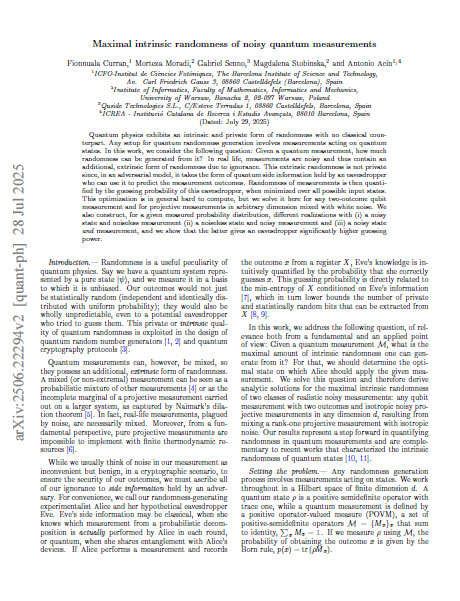
Fionnuala Curran, Morteza Moradi, Gabriel Senno, Magdalena Stobinska, Antonio Acín, Maximal intrinsic randomness of noisy quantum measurements
Quantum physics exhibits an intrinsic and private form of randomness with no classical counterpart. Any setup for quantum randomness generation involves measurements acting on quantum states. In this work, we consider the following question: Given a quantum measurement, how much randomness can be generated from it? In real life, measurements are noisy and thus contain an additional, extrinsic form of randomness due to ignorance. This extrinsic randomness is not private since, in an adversarial model, it takes the form of quantum side information held by an eavesdropper who can use it to predict the measurement outcomes. Randomness of measurements is then quantified by the guessing probability of this eavesdropper, when minimized over all possible input states. This optimization is in general hard to compute, but we solve it here for any two-outcome qubit measurement and for projective measurements in arbitrary dimension mixed with white noise. We also construct, for a given measured probability distribution, different realizations with (i) a noisy state and noiseless measurement (ii) a noiseless state and noisy measurement and (iii) a noisy state and measurement, and we show that the latter gives an eavesdropper significantly higher guessing power.
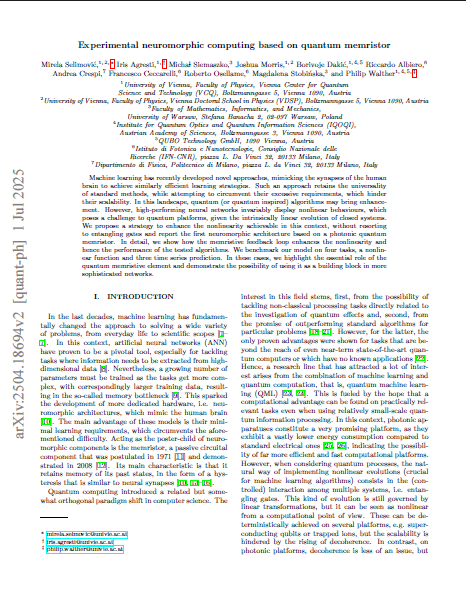
Mirela Selimović, Iris Agresti, Michał Siemaszko, Joshua Morris, Borivoje Dakić, Riccardo Albiero, Andrea Crespi, Francesco Ceccarelli, Roberto Osellame, Magdalena Stobińska, Philip Walther, Experimental neuromorphic computing based on quantum memristor
Quantum physics exhibits an intrinsic and private form of randomness with no classical counterpart. Any setup for quantum randomness generation involves measurements acting on quantum states. In this work, we consider the following question: Given a quantum measurement, how much randomness can be generated from it? In real life, measurements are noisy and thus contain an additional, extrinsic form of randomness due to ignorance. This extrinsic randomness is not private since, in an adversarial model, it takes the form of quantum side information held by an eavesdropper who can use it to predict the measurement outcomes. Randomness of measurements is then quantified by the guessing probability of this eavesdropper, when minimized over all possible input states. This optimization is in general hard to compute, but we solve it here for any two-outcome qubit measurement and for projective measurements in arbitrary dimension mixed with white noise. We also construct, for a given measured probability distribution, different realizations with (i) a noisy state and noiseless measurement (ii) a noiseless state and noisy measurement and (iii) a noisy state and measurement, and we show that the latter gives an eavesdropper significantly higher guessing power.

Morteza Moradi, Maryam Afsary, Piotr Mironowicz, Enky Oudot, and Magdalena Stobińska-Moretto, Long-range photonic device-independent quantum key distribution using spontaneous parametric down-conversion sources and linear optics
We address the question of the implementation of long-distance device-independent quantum key distribution (DI QKD) by proposing two experimentally viable schemes. Those schemes use only spontaneous parametric down-conversion sources and linear optics. They achieve favorable key rate scaling proportional to the square root of channel transmittance 𝜂𝑡, matching the twin-field protocol advantage. We demonstrate positive asymptotic key rates at detector efficiencies as low as 80%, bringing DI QKD within the reach of current superconducting detector technology. Our security analysis employs the entropy accumulation theorem to establish rigorous finite-size bounds, achieving finite-key rates at a detector efficiency of 90%. This work represents a critical milestone toward device-independent security in quantum communication networks, providing experimentalists with practical implementation pathways while maintaining the strongest possible security guarantees against quantum adversaries.
